

Up a Creek Without A Paddle
Baldface Creek is in the South Kalmiopsis Roadless Area, Oregon’s largest unprotected national forest wild area, directly adjacent to the congressionally protected Kalmiopsis Wilderness. Having grown up in Southern Oregon and worked on various initiatives, like the River Democracy Act to protect threatened rivers in this region, Baldface Creek has been a curiosity of mine for some time.
The logistics for this run can be tricky, but when the conditions align, it is a bucket-list run. Lucky for me, I am married to a person who has a unique skillset to pull together logistics for complicated paddling trips, and has earned knowledge of this area. So, when he saw a rare window where flows, access, and weather all lined up, I only needed to pack my gear and be up for the adventure.
Most people do Baldface as a very long day trip, starting the hike before sunrise. We decided to make it a multi-day trip so we could spend more time in this place. Access can be tough – depending on conditions, the trip usually involves hiking seven miles past a typically closed gate, which was the case for us. Closing in on the summit, the snow became increasingly deep. We were postholing through a deep and awful crust that kept breaking as soon as we took the next step – falling through the crust, sometimes up to our hips, with each step. This went on for 2 miles. 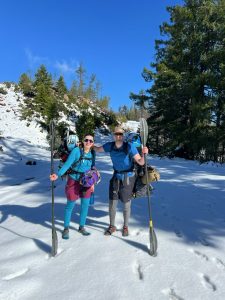
Once we reached the summit, we wanted to believe the hiking would get easier. It did not. Anyone who has carried weight down steep, uneven, rock-laden slopes knows the pain.
After a night of rest, the next day we started to make our way down the fast-moving creek until we reached a larger rapid, where the tone of the trip changed. My body had been acting up since the hike, and I was paddling tentatively, which never leads to good things. I missed a critical paddle stroke, got stuck in a hole, and swam out of my packraft. It had been some time since I had been in this situation – and in my panic I ditched both my paddle and my boat to get out of the river, leaving Jacob (my husband) to clean up the mess.
“Crap, why did I do that? That was the wrong thing to do. What a stupid mistake. I’m supposed to be better than this. What a beater move. I shouldn’t be here. What have I done?!”
Unfortunately, my paddle was not recovered – meaning we needed to resort to using the hand paddles we had brought. I would eddy-hop (catching the calm water between rapids) to make my way down the creek, portage (walk around rapids) as needed, and focus on safe downstream progress. It took some adjustment to get used to hand paddling, but after a while, I settled in and was actually having a lot of fun.
The next day brought more of the same, plus one larger rapid that required some creativity to portage. After the portage, I tried to ferry (crossing currents) across the river, flipped, and swam again. I quickly realized one of my hand paddles had not been tightened and had fallen off. Panic set in, realizing the weight of yet another error – I searched frantically; it seemed certain the hand paddle was gone. I was angry at myself and felt desperate. We calculated that hiking out would take two days. I looked along shore for anything I could use as a hand paddle and found a big piece of bark that I thought might work if I strapped it to my hand with a small cam-strap I had. I was ready to keep going and accept the weight of my mistakes.
Then, as I was strapping the piece of bark to my hand, I saw something flash at the bottom of the river. I called out to Jacob, realizing – hoping – it was the missing hand paddle. He grabbed the end of a throw bag (a commonly used rescue device containing a bag and specialized rope), handed me the other side, and I dove to the bottom of the river before the sunken plastic could get away from us and into the next rapid. “I’ve got it!”
Getting that hand paddle back dropped a heavy weight from our shoulders. It had been a while since we had been in that tight of a spot. I cinched the hand paddles around my wrist as tight as they would go and we continued downstream. I was determined not to make any more errors.
The next couple of days were fun read-and-run boating. I portaged several rapids to play it safe with the hand paddles and avoid more mistakes. At one steeper section with large ledge holes ( a feature with a steep drop and hydraulic), I watched Jacob boof over a notable ledge and signal back that I should walk it. But as I was following close enough through the busy section, the signal came too late. I was already committed. I put everything I had into a two-handed, hand paddle boof, made it over the hole (kind of like a butterfly swimming stroke), and rode out the rest of the rapid in a big stern squirt (where the stern of your boat catches a current, and pushes your bow upward, kind of like a wheelie on a bike), bringing my bow down with a huge smile and some renewed confidence.
At the end of the trip, I was taking my hand paddle off to get out of my boat, and dropped the dang thing again. Fortunately, I grabbed it before it sank and disappeared. I shook my head in humor and in disappointment that I had almost yet again fallen into complacency and let the hand paddle slip away again. In the end, it was a fun adventure, with both memories and lessons to bring home with us.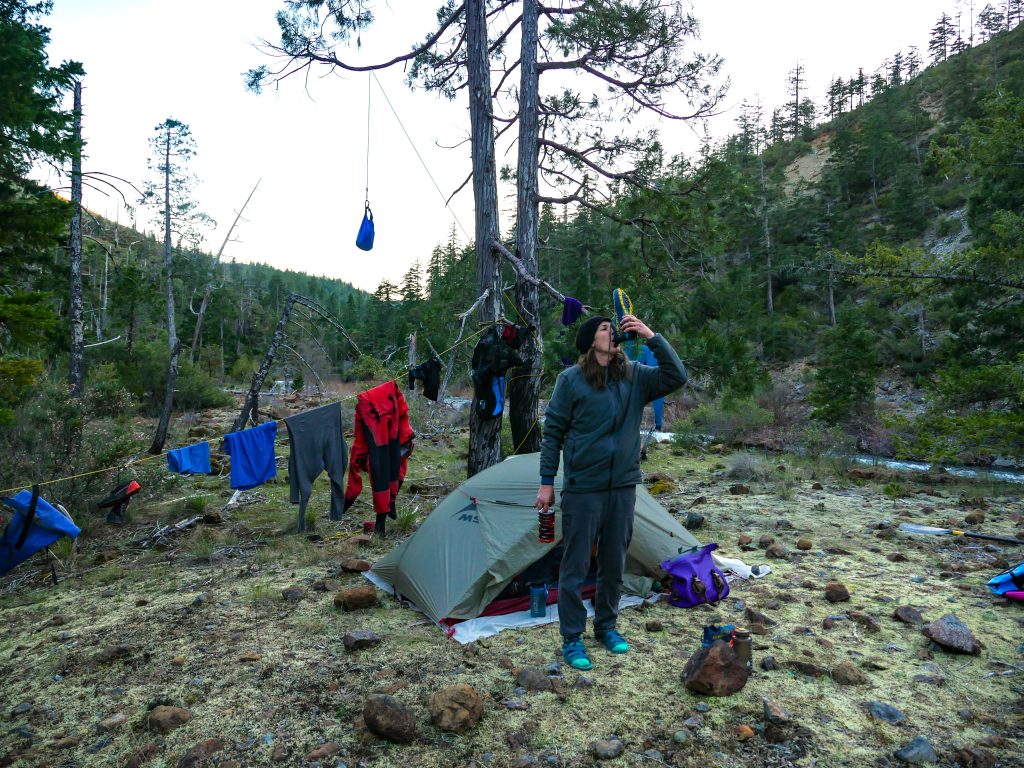
The river did not let me pretend I had everything figured out, nor let me pretend I had done everything I could to be prepared for this trip. Prior to this trip, I had taken a long break from paddling anything challenging, and should have realized my paddling was not what it used to be. My errors and the environment kept demanding that I adjust and keep moving downstream – with or without a paddle. I am lucky to have a partner who has put in the work to be an asset on the water, and who is there to help manage my mistakes — holding a rope for me, letting me follow his lines, and cleaning up when I swim. That role is not an easy burden to carry. So thank the people who help you get down the river, and out of the water when you are not paddling your best. Thank the people who help clean up the mess when your mistakes put you, and the group, in a tough spot. After the mistake is the important part: put in the work to be a better paddler so you can become the person holding the rope and showing the lines to others. We all find ourselves up a creek without a paddle sometimes, and we are all somewhere between swims. What matters is learning from the mistakes, adapting to the challenges, and recognizing the role we played in getting there. More often than not, the way forward and out comes through better preparation, a little humility, and the willingness to keep moving downstream.


About Post Author
